Part 5 of 5
The postal vote's
all-time high
In the 2023 election the postal vote reached its all-time high: 2.6 million applications, handled by Correos, whose chairman at the time had been Pedro Sánchez's chief of staff. The roll for 29 November is the one in force on 1 August, and postal ballots arriving from abroad will be checked against that same roll. No proven fraud has come out of that summer of 2023. What remains is a hypothesis.
The 2023 peak
In the 2023 election, 2.6 million postal-vote applications were filed, two and a half times more than in 2019, and 94.2% of applicants went on to vote, "the highest figure since 2008." Both figures come from Correos and are reported by Maldita.es; no original publication by the operator itself has been located.[2]
Correos's chairman
Running the company that summer was Juan Manuel Serrano, chairman of Correos from 2018 to 2023. Before taking the post he had been Pedro Sánchez's chief of staff, back when Sánchez was not yet prime minister. In July 2026, judge Pedraz, of the National Court, named him a formal suspect — the same judge investigating the so-called "Leire Díez case." The UCO police unit's report attributes to him a "leading role" (translated from the original Spanish) in a network of influence and contracts, according to the press that has cited that report. Being named a formal suspect opens an investigation into someone; it does not convict them.[3]
The case itself has nothing to do with the postal vote. The company that delivers, holds and hands over postal ballots was chaired, throughout the 2023 election, by the man who had been chief of staff to the person who is now prime minister. It is also, according to a financial profile by El Confidencial, a company in a precarious financial position.[4]
The PSOE's branches in Latin America
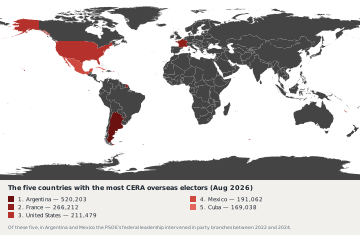
Between 2022 and late 2024 — the same window in which the grandchildren's law took effect and the overseas roll began to grow — the PSOE's federal leadership intervened in, dissolved, or replaced with caretaker committees the leaderships of its branches in Mexico and the Dominican Republic (2022), extended a caretaker committee in Uruguay, and replaced the leadership in Argentina (late 2024) — the country with the most electors on the overseas roll: 505,168 as of 1 May 2026, nearly one in five of the entire overseas roll. At that same date, the overseas roll totalled 2,708,083 electors, 375,027 more than at the 2023 general election, growing by as many as 16,000 people a month, according to a report by El Español.[5]
At a meeting in Buenos Aires with former local leaders protesting the extended caretaker committee, the federal executive's current secretary for overseas affairs, César Mogo, summed up the goal in three words, according to that same report: "Round up the votes" (translated from the original Spanish). The party's Ferraz headquarters maintains that these moves followed internal party rules and denies any electoral purpose. Nor is there any record — the reporting itself acknowledges this — that branch membership data, in one case a file of more than 8,000 contacts that "turned up deleted" (translated from the original Spanish), was used to court votes, or of any established link between the new naturalised membership and a particular voting pattern. That these internal party interventions followed a strategy to electorally capitalise on the overseas roll's growth is, on what has been published, a documented coincidence in timing, not a proven intent.[5]
The official in charge of the overseas vote
On 5 October 2026, with the campaign for 29 November already under way, the PSOE's Federal Executive Committee approved its Election Committee — led by Rebeca Torró, María Jesús Montero and Cristina Narbona — and named that same César Mogo, a senator for Lugo, as the official in charge of the overseas vote. Mogo had toured Latin America promoting the grandchildren's law and had publicly defended a reading of its scope broader than what the law itself sets out: in October 2025 he said it covered "the millions of people who have crossed oceans since the nineteenth century" (translated from the original Spanish); in an interview on Argentine television he said "we are making legal what was natural" (translated from the original Spanish); and in an opinion column he wrote "we don't just want them, we need them!" (translated from the original Spanish).[6]
That reading goes beyond what the law itself states — which requires proven exile for political reasons between 1936 and 1955 — and even beyond what the 2022 instruction widened it to, which only presumes that exile for those who left Spain in that specific period (see Part 2). Nineteenth-century economic emigration falls under no scenario in the eighth additional provision or its implementing instruction.[6]
A system with a history
Spain's postal vote has had a documented weak point for more than a decade: the law required identifying whoever requests a postal vote, but not whoever hands in the already-cast ballot at the Correos counter. The Office of the State Prosecutor General asked the Rajoy government to close that gap in 2012, after a case of fraud in Melilla. The request took eleven years to be acted on: it was only closed by a Central Electoral Board instruction of June 2023, following a fresh case of fraud in the same city that did not involve the PSOE.[7][8]
The only final conviction that exists in Spain for buying postal votes is, in fact, that 2008 case: the then secretary-general of the PSOE in Melilla and the leader of Coalición por Melilla were each sentenced to two years in prison, upheld by the Supreme Court in 2021, for handing in applications that had already been filled in and ballots already sealed in their envelopes.[9] The Partido Popular has two other final convictions for the same offence, in Fortuna (Murcia) and Baeza (Jaén), sentenced in 2012 and 2009.[10]
What changes across the 2019–2023 municipal election cycle is where the cases still open are concentrated. Three instructions currently active, over forged signatures or voter impersonation, point to PSOE officials or candidates: in Albaida del Aljarafe (Seville), where a forensic examination found signatures that did not match the ID holder's on 132 applications;[11] in Mojácar (Almería), where a witness testified that the signature on their application "was not theirs at all" (translated from the original Spanish);[12] and in Albudeite (Murcia), where the Provincial Court confirmed in April 2026 that the mayoral candidate and fourteen other suspects would face trial.[13] None of the three has yet reached a verdict. But nor is there, as of today, any equivalent active instruction against the PP; the only open case involving another party again points to Coalición por Melilla, in an episode distinct from the one in 2008.[14]
And the system's fragility is not only a documentary one: it is also a matter of ease of access and lack of custody. A cast ballot travels inside an ordinary mail sack, and that sack has been stolen on three documented occasions, without anything being forged. On 17 June 2016, in Madrid, a postal worker left the cart carrying the sack unattended in a building entrance in the Moratalaz district while delivering a parcel upstairs; when he returned, it had vanished — with at least 27 ballots for the June 2016 general election — and part of the contents were later found scattered 250 metres away.[15] A woman was arrested in Melilla, during the November 2019 election rerun, carrying more than 30 postal ballots that, according to the investigation, came from a bag snatched from a postal worker mid-round.[16] The third case hit the Correos branch in Fuente de Cantos (Badajoz), in December 2025: an organised group forced their way in and made off with the safe, containing 124 already-cast ballots for the Extremadura regional election and €14,000 in cash; the Civil Guard attributed the theft to a gang responsible for fifteen other robberies at branches across the region. The ballots later turned up burned and scattered on the ground, and the Electoral Board authorised the 124 affected voters to vote again.[17] In none of the three cases is there any record that the theft altered how the stolen vote was cast — these are thefts, not forgeries — but all three fail at the same point: once a ballot leaves the counter, it is protected no better than any ordinary parcel.
This is where it connects to the rest of this part. The man who chaired Correos during the 2023 election had been Sánchez's chief of staff. And the Correos senior official who held signing authority over the postal vote in the 2022 regional elections — now under investigation in a separate case, led by the same judge investigating the Correos case — had begun her career as a Socialist councillor in a town where the postal vote had also raised suspicions, in 2011, never proven.[18] None of these threads proves anything on its own. Together they describe a system whose weak point has already been exploited before, and whose currently open cases — with no conviction yet — are concentrated around the party in government.
Comparing this with other democracies does not soften it: it sharpens it. The Council of Europe, through its Venice Commission, does not treat postal voting from abroad as a neutral method: its code of good practice in electoral matters authorises it only where the postal service is "secure and reliable" and "fraud and intimidation are not possible" (translated from the Spanish rendering cited by this report's sources) — a condition, not a free pass.[19] That is why a broad group of democracies — Argentina, Brazil, South Korea and Israel among them — avoids the post altogether for its citizens abroad and requires them to appear in person at a consulate.[20] And when this method fails elsewhere, it is not a hypothesis: Italy has had two documented manipulation scandals in its overseas constituency, in 2006 and in 2018, neither ending in a final conviction;[21] and in December 2024 Romania's Constitutional Court annulled its entire presidential election after detecting, among other signs of manipulation, an anomalous level of support — around 80% — for a single candidate among the diaspora.[22] In Spain's own CERA circuit, unlike the domestic postal vote, there is to date no documented or litigated case of fraud. But it is precisely through that method — postal, with no in-person step, and with the Venice Commission's condition yet to be shown to hold — that the overseas roll is now growing at its fastest rate in recent history, largely through the grandchildren's law (see Part 2).
The hypothesis for 29 November
What remains is a hypothesis, and only that. It holds that the government's circle retains the tools to intervene in the postal vote for 29 November — control of the postal operator, internal party control over the branches abroad, the appointment to head the overseas vote of someone who has publicly argued for an expansive reading of the law, and the use of the electoral roll and the administrative route the instruction opened — and that it could use them on a larger scale than in 2023. It is a hypothesis about what can be done. No source establishes that it will be done. None establishes that it was done in the 2023 election either.
That line between what is established and what is merely suspected runs through this entire case, and it is drawn case by case in the Sources inventory. Whatever becomes clear after 29 November will arrive too late: once ballots are in the box, the count cannot be redone.
References
- Crónicas de la Emigración, "El CERA para los comicios generales del 29 de noviembre se sitúa en estos momentos en más de 2,7 millones de inscritos," E. F. (Vigo), 7 October 2026. cronicasdelaemigracion.com.
- Maldita.es, "Récord en el voto por correo para el 23-J con 2,6 millones de solicitudes, dos veces y media más que en 2019," 14 July 2023 (maldita.es), and "En las elecciones del 23-J no se ha quedado sin votar por correo más gente que en el resto: el 94,2 % de los solicitantes ha votado," 22 July 2023 (maldita.es).
- El País, "El juez Pedraz imputa al expresidente de Correos y avala que se investigue su móvil por el 'caso Leire Díez'," 10 July 2026. elpais.com
- El Confidencial, "Radiografía a la delicada situación financiera de Correos…".
- El Español, "Ferraz se hizo con el control de cuatro agrupaciones del PSOE en Latinoamérica tras la 'ley de nietos': 'Junten votos'," Guillermina Leudesdorf, 13 July 2026. elespanol.com.
- El Español, "El PSOE encarga el voto exterior ante el 29-N al senador que incluyó en la 'ley de nietos' a los que emigraron 'en el siglo XIX'," Íñigo Zulet, 5 October 2026. elespanol.com.
- InfoLibre, "La Fiscalía General pidió a Rajoy en 2012 un cambio en la ley electoral para evitar la compra de votos por correo." infolibre.es.
- Central Electoral Board Instruction 5/2023, of 8 June, on personal identification when handing in a postal vote. BOE-A-2023-13667.
- Judiciary (CGPJ), press note, "El Tribunal Supremo confirma la pena de dos años de prisión al presidente de Coalición por Melilla y al exsecretario general del PSOE de Melilla por falsedad y dos delitos electorales." poderjudicial.es.
- El Derecho, "El Tribunal Supremo condena por delito electoral al alcalde de Fortuna (Murcia) por comprar votos para el PP." elderecho.com; Iustel, summary of Supreme Court ruling STS 1125/2009 (Baeza, Jaén case). iustel.com.
- The Objective, "La Guardia Civil detecta irregularidades en el voto por correo que benefician al PSOE," 24 April 2025. theobjective.com.
- esdiario.com, on the Mojácar (Almería) case, 10 March 2026. esdiario.com.
- Judiciary (CGPJ), "La Audiencia Provincial de Murcia confirma la continuación del procedimiento por la presunta compra de votos en Albudeite," 16 April 2026. poderjudicial.es.
- El Debate, "La jueza levanta, tres años después, el secreto de la pieza principal de la presunta compra de votos en Melilla de 2023," 9 May 2026. eldebate.com.
- El País, on the theft of a mail sack containing postal votes in Moratalaz (Madrid), 17 June 2016. elpais.com.
- El Mira, "Roban los votos por correo a una cartera para meter los sobres de un partido," on the Melilla case, 9 November 2019. elmira.es.
- eldiario.es, "Roban 14.000 euros y 124 votos de las elecciones extremeñas en una oficina de Correos de un pueblo de Badajoz," 18 December 2025, and "La Guardia Civil desarticula el grupo al que se le atribuye el robo de los votos por correos en Extremadura"; Maldita.es, fact-check of the case. eldiario.es.
- Vozpópuli, "La 'fontanera' del PSOE validaba el voto postal desde su puesto en Correos." vozpopuli.com.
- Venice Commission (Council of Europe), Code of Good Practice in Electoral Matters, CDL-AD(2002)023rev2-cor, guideline I.3.2. venice.coe.int.
- Wikipedia, "Non-resident citizen voting" (a country-by-country list aggregated by Wikipedia editors, not checked one by one against each state's official source). en.wikipedia.org.
- IrpiMedia, "Brogli elettorali 2018 alla circoscrizione Estero, il senatore Cario resta in carica," on the 2018 scandal; with background on the 2006 case from "2006 Italian Senate election, North and Central American division" (Wikipedia). irpimedia.irpi.eu.
- CNN, "Romania's top court annuls presidential election result," 6 December 2024. cnn.com.
Numbered in order of first citation in the text. See also Sources.