Part 4 of 5
The amendment
that was never voted on
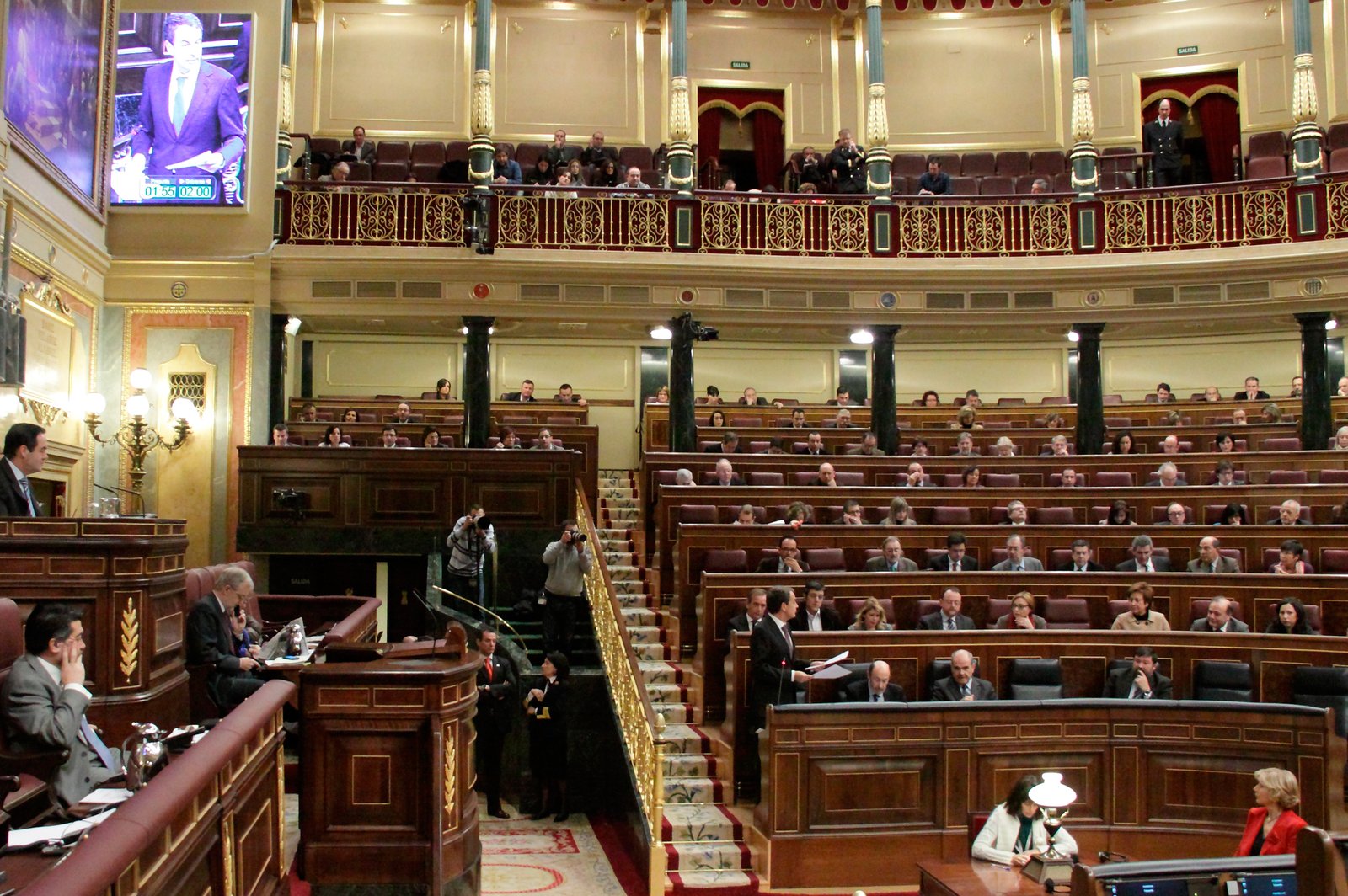
The legal counsel of Congress's Education Committee warned in writing that the amendment had no connection whatsoever to the law it was meant to be inserted into. The PSOE and Sumar admitted it for consideration anyway, on 30 September 2026, and five days later Parliament was dissolved and it lapsed without ever being voted on. Behind it lie four years of history: the Democratic Memory Law dates from 19 October 2022, the instruction that widened it from the 25th, and the Supreme Court had suspended its electoral effects three weeks before that committee meeting.
Ten minutes in committee
The Bureau of Congress's Education Committee met on 30 September 2026 and disposed of the matter in ten minutes. It admitted amendment no. 63 to the education bill for consideration by three votes to two, the PSOE's two plus Sumar's one against the PP's two.[1]
The amendment had been filed on 16 September. It belongs to Sumar, Yolanda Díaz's party, and was tabled by deputies from Izquierda Unida within that parliamentary group. What it asked for was to raise to the rank of law the presumption of exile set out in the instruction signed by Sofía Puente, the one the Supreme Court had just halted. It asked for this through the articles of a bill regulating education, which had nothing to do with who gets to vote.[1]
Before the Bureau ruled, the Committee's legal counsel, Fernando Dorado, had put his objection in writing. Between the bill's subject matter and the amendment, he concluded, there was not "the slightest point of substantive connection" (translated from the original Spanish), and he cited Constitutional Court doctrine on the subsidiary nature of any amendment with respect to the text it amends. The report is his, as the Committee's own legal counsel; the press attributed it to Congress's legal staff as a body.[1]
The report was not binding. The Bureau could depart from it without breaking any rule, and it did. But the document is signed and dated before the vote, and it states plainly that the amendment had no connection to the law it was being inserted into. The PSOE and Sumar pushed it through with that warning already on the table. That the attempt to shield the instruction was made there, with that warning in plain view, is as close as this case comes to proof of intent.[1]
The committee vote was scheduled for 14 October. On 5 October Parliament was dissolved and the amendment lapsed with the election call, without ever being voted on. There is no measure left to examine. What remains is the attempt.[1]
Narrower than the instruction
Sumar's text bounded the period to between 18 July 1936 and 31 December 1955, which made it narrower than the instruction itself. According to ABC, consulates had been applying the instruction also to descendants of emigrants who left before 1936, whom the amendment would no longer have covered.[1]
The 2 October headline
A story circulated that on 2 October the Supreme Court had sidestepped the amendment. The court ruled on nothing that day. What actually happened was an analysis piece by El Confidencial, with a headline its own text does not support. The amendment, as drafted, contained no retroactivity clause and no provision extending its effects to earlier cases, so that, according to the legal sources consulted by that outlet, it would not reach the nearly 400,000 already registered — the figure in its own headline; its own text puts the number at close to 370,000 as of 31 August — and would leave the proceeding before the Supreme Court very much alive. The move would have changed the rules only going forward.[2]
The milestones
The Bureau's vote falls in the final stretch of a four-year process. These are its dates, from 2022 to 29 November.
- 19 Oct 2022Law 20/2022 on Democratic Memory
Its eighth additional provision opens the path to nationality for descendants of exiles.[3] - 25 Oct 2022Sofía Puente's instruction
Widens the application of the eighth additional provision. Published in the official gazette (BOE-A-2022-17470).[4] - 2023–2025The process stays open for three years
The deadline runs out in October 2025.[5] - 16 Jul 2026Central Electoral Board ruling 204/2026
The ruling everything else about the overseas roll stems from; four members sign a dissenting opinion.[6] - Jul 2026Appeals filed with the Supreme Court
Iustitia Europa (appeal 1013/2026) and Vox (appeal 1015/2026).[7] - 7 Sep 2026The Prosecutor's Office opposes the suspension
One day before the order.[8] - 8 Sep 2026The Supreme Court grants the injunction
Suspends CERA registration for cases arising from the instruction; excludes proven exiles.[7] - 14 Sep 2026The Central Electoral Board complies with the order
Technical instructions issued to consular offices.[9] - 16 Sep 2026Sumar files amendment no. 63
In an education bill, to raise to the rank of law the instruction's presumption of exile.[1] - 22 Sep 2026The State Legal Service appeals
Calls it impossible to review 170,000 cases before 2027.[10] - 30 Sep 2026The Education Committee's Bureau admits it for consideration
Three votes (PSOE and Sumar) to two (PP), against the legal staff's own report.[1] - 2 Oct 2026El Confidencial publishes its analysis of the amendment
With no retroactivity clause, it would not reach the nearly 400,000 already registered, according to that outlet's legal sources. The Supreme Court rules on nothing that day.[2] - 5 Oct 2026The 29 November election is called
Iustitia Europa files an urgent brief asking for the injunction to be enforced. The dissolution of Parliament lets the amendment lapse; it had been due for a vote on 14 October.[11] - 29 Nov 2026General election
The other two routes
Parliament was not the only front.
The legal route · The Supreme Court and the Central Electoral Board
The appeals filed by Iustitia Europa and Vox against the Central Electoral Board's ruling, the 8 September injunction, and whether or not it is enforced before 29 November. This is the route that would actually have reached the electoral roll.[6][7]
The EU route · The Court of Justice of the EU
Iustitia Europa has announced that it is considering a preliminary reference to the Court of Justice of the EU on the instruction's effects. As of this edition's closing, it remains an announcement, not a filing.[12]
The case's international reach — coverage by the Financial Times, Reuters, Le Monde and the Latin American and French press — is set out in Sources.
All three routes argue over the same thing, who appears on the roll for 29 November, and none of them has time left to change it: the amendment lapsed, the EU question is still only an announcement, and the injunction remains unenforced. What is left is the other half of the matter. How many of those on the roll will vote without ever setting foot in a polling station, and whose hands those ballots pass through.
References
- Amendment no. 63 (Sumar) to the education bill: The Objective, "PSOE y Sumar ignoran a los letrados y cuelan en la Ley de Educación legalizar la 'ley de nietos'," 30 September 2026 (theobjective.com); El Español, 1 October 2026 (elespanol.com); ABC, 30 September 2026 (abc.es); El Confidencial, 30 September 2026 (elconfidencial.com); Libertad Digital, 30 September 2026 (libertaddigital.com); okdiario (okdiario.com); Maldita.es (maldita.es).
- El Confidencial, "El TS esquiva la enmienda 'trampa' del Gobierno y no se aplicará a los casi 400.000 inscritos," 2 October 2026. elconfidencial.com.
- Law 20/2022 of 19 October on Democratic Memory, eighth additional provision. BOE-A-2022-17099.
- Instruction of 25 October 2022 from the Directorate-General for Legal Security and Public Trust. BOE-A-2022-17470.
- Newtral, "¿Podrán votar los nacionalizados por la 'ley de nietos' el 29 de noviembre?," 5 October 2026. newtral.es.
- Central Electoral Board, rulings by session (2026). juntaelectoralcentral.es.
- CGPJ, "El Tribunal Supremo estima la medida cautelar…," 8 September 2026 (identifies the two appeals, 1013/2026 from Iustitia Europa and 1015/2026 from Vox). poderjudicial.es.
- El País, "La Fiscalía se opone en el Supremo a que se suspenda la inscripción en el censo…," 7 September 2026. elpais.com.
- Central Electoral Board ruling of 14 September 2026 (file 209/361). juntaelectoralcentral.es (PDF).
- El Debate, "La Abogacía recurre la paralización de la ley de nietos y ve imposible revisar 170.000 expedientes antes de 2027," 22 September 2026. eldebate.com.
- The Objective, "Piden al Supremo que el censo del 29-N no incorpore altas paralizadas…," 5 October 2026. theobjective.com.
- Pardo (Iustitia Europa): announcement of the EU route, 22 September 2026. YouTube; The Objective.
Numbered in order of first citation in the text. See also Sources.